How to Choose a Commercial Asphalt Contractor in Northwest Arkansas
Every summer in Northwest Arkansas, property managers get the same call. Someone has "leftover material from a job down the road" and can seal your lot today for cash. By September the sealer is grey, the cracks are back, and the phone number does not work. Meanwhile the property manager down the street paid 30 percent more, got a written scope, and their lot still looks sharp two years later.
Choosing a commercial asphalt contractor is not about finding the lowest number on a page. It is about finding the company that will still be answering the phone when a seam opens up next spring. This guide walks through exactly how we recommend commercial owners, HOA boards, and facility managers across Fayetteville, Springdale, Rogers, Bentonville, and Fort Smith evaluate a paving contractor before signing anything.
Commercial Work Is Not Residential Work
The first filter is the simplest one. Ask what percentage of the contractor's work is commercial. A crew that spends most of its time on residential driveways is not equipped for a 60,000 square foot retail lot with live traffic, ADA requirements, fire lane markings, and a tenant base that cannot lose access for three days.
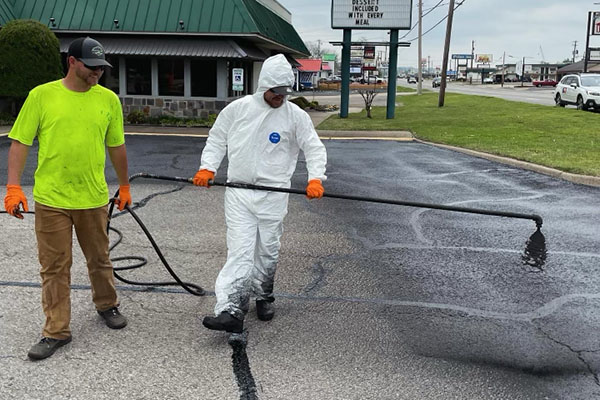
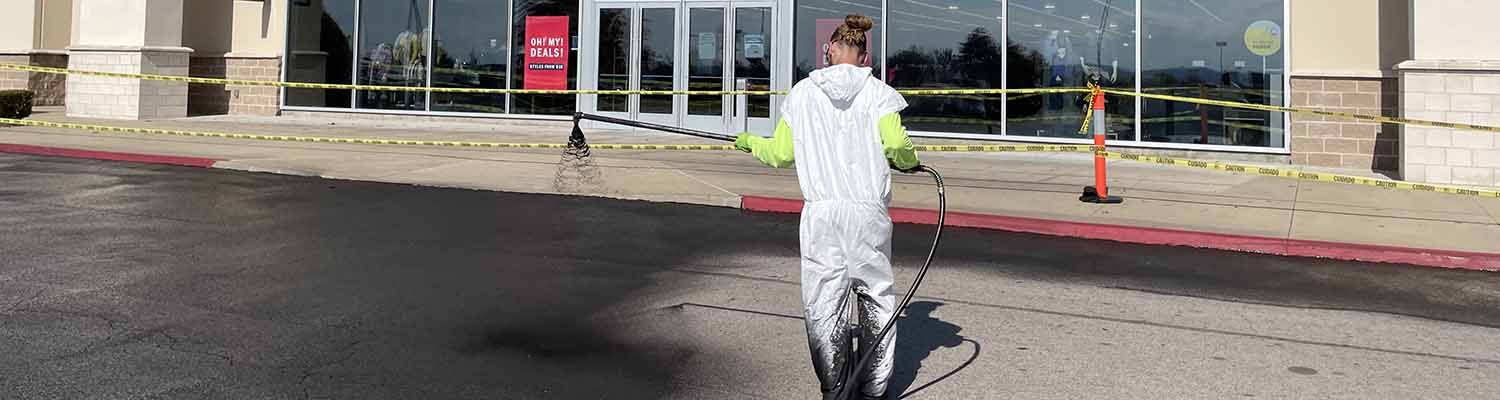
Commercial asphalt work involves things residential work never touches: phased lot closures so the business stays open, traffic control plans, ADA stall counts and van-accessible aisles, drainage and grade correction, heavier base sections built for delivery trucks and refuse vehicles, and coordination with property management, tenants, and sometimes municipal inspectors.
A contractor who does this work daily will talk about phasing and traffic control before you bring it up. That is the tell.
Verify the Basics Before Anything Else
Before you evaluate scope or price, confirm the contractor clears these baseline checks:
- General liability insurance with coverage appropriate to your property size, and a certificate naming you as additional insured
- Workers compensation coverage for every crew member who will be on your property
- A physical local address, not just a cell number and a magnetic door sign
- Arkansas contractor licensing where the project scope requires it
- References from commercial properties, not just homeowners
- Proof of owned equipment rather than everything rented job to job
Ask for the certificate of insurance directly from the insurer, not a PDF forwarded by the contractor. It takes one email and it eliminates a category of risk entirely. If a crew member is injured on your property and the contractor has no workers comp, that exposure can land on you.
Read the Scope, Not Just the Price
Most bad paving outcomes are not fraud. They are scope gaps. Two bids on the same lot can differ by thousands of dollars purely because one of them quietly excludes work the other includes.
A real commercial scope of work spells out:
- Square footage measured on site, not estimated from satellite imagery
- Surface prep: power broom, blow off, hand scraping, washing where needed
- Crack sealing: linear feet, sealant type, and whether it is included or separate
- Patching and pothole repair: locations, depth, and method
- Material spec: sealer family and manufacturer, or asphalt mix design and compacted depth
- Number of coats or lifts, with application rate per square yard
- Striping: stall count, ADA stalls, arrows, fire lanes, curb painting
- Cure time and reopening plan in written hours
- Warranty terms with a start date and a defined remedy
- Cleanup and disposal of millings and debris
If any of those ten lines is missing from a bid, that is not a cheaper contractor. That is an incomplete bid. Our post on what a real sealcoating bid includes breaks the sealcoating side of this down line by line.
Comparing Bids the Right Way
Put every bid into the same format before you compare. Normalize to cost per square foot for each line item, then compare like for like. A $6,400 bid and a $9,100 bid on the same lot are not comparable until you know whether both include crack sealing, both spec two coats, and both restripe.
Watch for these patterns:
| Signal | What it usually means |
|---|---|
| --- | --- |
| Bid is 40 percent below the others | Missing scope, thinned material, or single coat |
| No square footage listed | The contractor never measured the lot |
| "Sealcoat as needed" language | No committed application rate |
| Striping listed as "restripe existing" only | ADA non-compliance will not be corrected |
| Warranty is verbal | There is no warranty |
| Full payment required up front | Cash flow problem or fly-by-night operation |
Deposits on large commercial projects are normal. Full prepayment before mobilization is not.
Questions That Separate Real Contractors From Salespeople
Ask these on the walkthrough and listen to how quickly the answers come:
- How did you measure this lot?
- What is the mix design or sealer spec you are proposing, and why this one for my property?
- How many coats or lifts, at what application rate?
- Are cracks and potholes handled before the surface work, and is that in this price?
- How will you phase the work so my tenants keep access?
- What is the cure time before I can reopen each section?
- Who is the on-site foreman and how do I reach them during the job?
- What does your warranty cover, and what voids it?
- Can I see two commercial properties you did three years ago?
That last question matters most. Anyone can show you a lot they sealed last week. A lot that still looks good after three Arkansas summers and three freeze-thaw winters tells you everything about the crew's prep work.
Red Flags Worth Walking Away From
- Door-to-door solicitation with "leftover material"
- Pressure to sign today for a discount that expires this afternoon
- No written contract, only a handshake and a verbal number
- Out-of-state plates with no local address
- Refusal to provide insurance certificates
- Vague answers about material specs
- A bid that fits on a business card
Every one of these shows up in Northwest Arkansas every single summer, usually right after a stretch of hot dry weather when lots start looking faded.
Timing and Scheduling in Northwest Arkansas
The regional paving season runs roughly late April through early October. Sealcoating needs surface temperatures above 50 degrees and rising, with a 24 hour dry window after application. Hot mix paving has more latitude but still suffers in cold or wet conditions.
Book early. Reputable commercial crews fill their July and August calendars by May. If a contractor can start your 80,000 square foot lot tomorrow in the middle of peak season, ask why they have an open crew.
Also plan around your own business cycle. Retail centers usually phase work overnight or across weekdays. Churches work best Monday through Thursday. Schools and universities target summer breaks. Medical and clinic properties need low-odor products and tight phasing. A good contractor plans around your operations instead of asking you to plan around theirs.
Building a Long-Term Relationship Instead of Buying a Job
The best outcome is not a good price on one job. It is a contractor who knows your property, tracks its condition year over year, and tells you what to budget for next season before you have to ask. That relationship turns pavement from an emergency expense into a predictable line item.
Ask any contractor you are considering whether they provide condition assessments and multi-year maintenance plans. A company that only sells one-off jobs has no incentive to extend the life of your existing surface. A company that manages your pavement over time does.
Get a Written Scope You Can Actually Compare
If you are collecting bids for a commercial parking lot anywhere in Northwest Arkansas or the River Valley, we will walk your property, measure it on site, and give you a fully itemized written scope with clear pricing and no pressure. Compare it line by line against anything else you have received.
See our commercial parking lot maintenance services for what we handle, or request a free estimate and we will get on your calendar.