Coal Tar vs Asphalt Emulsion vs Acrylic Sealer: Which Is Right?
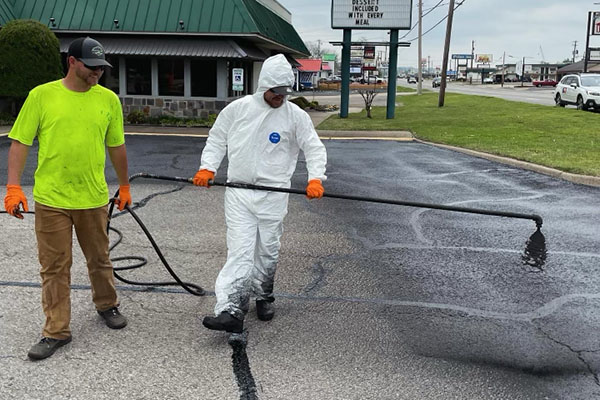
Most commercial property owners in Northwest Arkansas have never been asked which sealer they want on their parking lot. They got whatever the contractor brought to the site. That is fine when the contractor brings the right product. It is expensive when they bring the wrong one. This guide breaks down the three sealer families used in commercial work, where each one wins, and what to actually specify on your next bid.
Why the Sealer You Choose Actually Matters
Sealcoating is not a commodity. The three main sealer chemistries differ on lifespan, oil and fuel resistance, application temperature window, regulatory status, odor, look, and cost. Pick the wrong one for your property and you can:
- Lose 12 months of lifespan
- Watch oil spots bleed through within weeks
- Violate a local or state restriction
- Pay 30 percent more than needed for performance you do not need
- Get a lot that looks gray and dusty months after a reseal
Pick the right one and the lot looks better, lasts longer, and costs less per year of service life. That is the entire game.
The Three Sealer Families
Every commercial sealer on the market is a variation of one of three base chemistries.
Refined Coal Tar Sealer (RTS)
The original commercial parking lot sealer. Made from refined coal tar pitch, mixed with water, clay, and additives to control flow and cure.
- Best-in-class resistance to gasoline, diesel, and motor oil
- Deep, uniform black color that holds up under UV
- Long track record on commercial pads, fuel stations, and airports
- Typically the longest-lasting of the three on heavy-use lots
- Banned or restricted in some states and municipalities (not Arkansas at the state level, but worth checking your city)
- Strong odor during and immediately after application
- Tighter application weather window
- Some HOAs and residential boards prefer to avoid it on appearance and perception grounds
Asphalt Emulsion Sealer (AE)
Made from the same petroleum asphalt that paves the lot, emulsified in water with surfactants, clay, and polymers.
- Lower VOC than coal tar, less odor on application
- Friendlier in residential, HOA, and mixed-use settings
- Easier to handle, broader application window
- No regulatory issues anywhere in the United States
- Chemically the same family as the asphalt it is protecting, so it bonds well
- Less fuel and oil resistance than coal tar
- Tends to gray out a little faster under UV
- Slightly shorter lifespan on heavy-traffic commercial pads
- Quality varies a lot between manufacturers, so the spec matters
Acrylic and Polymer-Modified Sealer
Higher-performance sealers built on acrylic polymers, sometimes blended with asphalt emulsion. Used where appearance, color, or extreme conditions matter.
- Longest lifespan, often 5 to 7 years on the right surface
- Color options beyond black (used on tennis courts, sport surfaces, branded entrances)
- Excellent UV resistance, holds color longer
- Used on airports, sports complexes, and high-end commercial work
- Significantly more expensive per gallon
- Overkill for most standard parking lots
- Requires specialized prep and application
Side-by-Side Comparison
| Factor | Coal Tar | Asphalt Emulsion | Acrylic |
|---|---|---|---|
| --- | --- | --- | --- |
| Typical lifespan (NWA commercial) | 3 to 4 years | 2 to 3 years | 5 to 7 years |
| Cost per square foot | Mid | Lowest | Highest |
| Fuel and oil resistance | Excellent | Fair to good | Good |
| UV color retention | Very good | Fair | Excellent |
| Odor during application | Strong | Mild | Mild |
| Application weather window | Narrower | Wider | Narrowest |
| Best use case | Commercial pads, fuel stations | HOA, office, retail | Airports, sport surfaces, premium |
These are real-world ranges for Northwest Arkansas conditions on a properly prepped two-coat application. Single-coat work or watered-down product cuts every number in this table.
What We Typically Recommend in NWA
For most commercial parking lots in Fayetteville, Bentonville, Springdale, and Rogers, the right call is one of two specs:
Refined coal tar, two coats, with oil-spot primer. For QSRs, fuel stations, grocery stores, industrial yards, and any lot with steady drips and spills. The fuel and oil resistance is worth the marginally tighter weather window.
Asphalt emulsion, two coats, polymer modified. For HOAs, churches, professional office, light retail, and any property where odor or perception matters more than maximum fuel resistance. Modern polymer-modified emulsions close most of the lifespan gap with coal tar on these lower-impact lots.
Acrylic comes up for specialty work. A branded customer entrance painted in a corporate color, a sport court, a country-club roundabout. It is not the default for a standard lot.
Best Fit by Property Type
| Property type | Recommended sealer | Why |
|---|---|---|
| --- | --- | --- |
| QSR or drive-thru | Refined coal tar | Constant fuel and oil exposure |
| Gas station or convenience | Refined coal tar | Maximum fuel resistance |
| Grocery store | Refined coal tar or premium emulsion | High traffic, occasional spills |
| Retail strip center | Polymer-modified emulsion | Balanced cost and life |
| Office park | Polymer-modified emulsion | Lower odor for tenants |
| Medical or clinic | Polymer-modified emulsion | Low odor during business hours |
| HOA or condo | Polymer-modified emulsion | Resident-friendly, no perception issues |
| Church | Polymer-modified emulsion | Cost-effective on light use |
| Industrial truck yard | Refined coal tar | Heavy fuel and hydraulic exposure |
| Sport court or premium entry | Acrylic | Color options and longevity |
If you are not sure which bucket you fall into, the safe move is to ask any contractor bidding the job to specify which product they are using, why, and what the application rate per square yard is. Real commercial contractors answer that question without hesitation.
What Matters More Than the Brand
A premium sealer applied badly will lose to a basic sealer applied well. Once you have picked the right family, these application factors decide whether the lot lasts.
- Surface prep. Power broom, blow off, scrape, and wash. Any debris under the sealer breaks the bond.
- Oil-spot primer. Old oil and fuel stains need a primer or they will bleed through.
- Crack sealing first. Sealcoat is not a crack repair. Open cracks must be sealed before sealing.
- Mix ratio. Over-dilution is the most common cheat. Ask for the spec and ask if they meter it on site.
- Two coats. One coat for commercial work is a corner cut. Always.
- Application rate. Measured in gallons per square yard, varies by product. Make the contractor commit to a number.
- Cure time. 24 hours minimum before light traffic, 48 to 72 hours before heavy. No exceptions.
- Weather window. Surface temp above 50 degrees, no rain for 24 hours, low humidity preferred.
Get those right and a mid-tier product outperforms a premium product applied carelessly.
Common Myths About Sealer Selection
"Coal tar is banned everywhere now." False. It is restricted in a handful of states and municipalities, but legal across most of Arkansas. Check locally for your city.
"Asphalt emulsion is always cheaper." True on material, not always on lifespan. A coal tar job that lasts a year longer can be cheaper per year of service.
"All sealer is the same after the first coat." False. Mix ratio and coat thickness vary widely between contractors, and so does the lifespan.
"Color tells you the sealer quality." False. Any sealer looks black for the first week. Quality shows up at month 18, not week 1.
"One coat is fine for small lots." False. Two coats is the commercial standard regardless of lot size. The cost difference per square foot is small. The lifespan difference is large.
Questions to Ask Any Sealcoating Contractor
Before you sign a sealcoating contract, get a clear answer to every one of these:
- Which sealer family and which manufacturer?
- How many coats?
- What application rate per square yard?
- What is your mix ratio, and do you meter on site?
- Are oil spots primed before sealing?
- Are cracks sealed before sealcoating, or quoted separately?
- What cure time do you specify before traffic?
- What is the warranty on workmanship?
- Will you restripe after, and is it on the same quote?
A real commercial contractor answers all nine in plain English. A bid that dodges any of them is the bid you do not sign. Our one coat or two post digs deeper into the coats question, and our what is pavement sealcoating primer covers the basics if you want to brush up before bid day.
What a Real Commercial Sealcoating Bid Includes
If you have ever compared two sealcoating bids and wondered why one is $4,200 and the other is $7,800 on the same lot, the answer almost always lives in the line items. A real commercial bid includes most of these as separate, priced lines:
- Mobilization and traffic control. Cones, signage, lot phasing if the business stays open.
- Surface cleaning. Power broom, blow off, hand scrape, and wash where needed.
- Oil-spot priming. Listed separately so you can see it was actually included.
- Crack sealing. Either as a per-linear-foot number or a lump sum based on a walk count.
- First coat of sealer. Material spec and application rate per square yard.
- Second coat of sealer. Same spec, same rate.
- Cure time and lot reopening plan. Written commitment on hours before traffic.
- Restriping. Line count, ADA stalls, directional arrows, fire lane markings.
- Warranty terms. Written, time-bound, in plain English.
The cheaper bid is almost never cheaper because the contractor is more efficient. It is cheaper because one or more of those lines is missing. Find the missing line and you find your answer.
How This Connects to the Rest of Your Maintenance Plan
Sealer selection is one decision inside a larger asphalt strategy. The sealer protects the surface, but the surface only matters if the structure underneath is sound. The full sequence on a healthy commercial lot looks like:
- Annual crack sealing to keep water out
- Spot pothole repair as needed to keep failures from spreading
- Sealcoating every 2 to 4 years to renew UV and oil protection
- Restriping with each sealcoat to keep ADA and safety markings sharp
- Mill and overlay or full repave when the structure ages out, typically 20 to 25 years on a well-maintained lot
Skip any of the first four and the fifth one arrives a decade early. Get all four right and the fifth one keeps getting pushed. The sealer you pick determines how long step three lasts inside that cycle.
Ready to Spec the Right Sealer?
The sealer choice is one decision in a longer maintenance plan, but it is one of the few where the wrong call costs you a full year of pavement life. See our parking lot sealcoating service for what a properly specified commercial sealcoat job looks like, or request a free estimate and we will walk your lot, recommend the right product for your property, and put it in writing.