How Summer Heat Damages Asphalt in Northwest Arkansas
Every June in Northwest Arkansas the pavement season shifts into a completely different gear. The mild spring rains give way to long stretches of 90 degree afternoons, humid nights, and surface temperatures on dark asphalt that can climb well past 140 degrees. For property managers, HOA boards, and commercial owners across Fayetteville, Springdale, Rogers, and Bentonville, this is the time of year when small pavement problems turn into expensive ones almost overnight.
At Parking Lots Plus we spend the summer months walking lots, measuring cracks, and writing repair plans, and we see the same patterns repeat year after year. Understanding exactly how summer heat damages asphalt is the first step toward getting ahead of it, so in this guide we are breaking down what actually happens to your pavement between June and September and what a smart maintenance response looks like.
Why Asphalt Is So Vulnerable to Heat
Asphalt pavement is a flexible material made from stone aggregate bound together with asphalt cement, a petroleum based binder. That binder is what gives the surface its rich black color and its ability to flex slightly under traffic loads. It is also the single most vulnerable part of the pavement system when temperatures rise.
When the sun beats down on a parking lot for hours at a time, three things happen simultaneously. First, the binder softens and becomes more pliable, which can lead to rutting under heavy vehicles like delivery trucks and dumpsters. Second, ultraviolet radiation attacks the chemical structure of the binder itself, breaking down the long molecular chains that give asphalt its strength and elasticity. Third, the daily cycle of heating and cooling creates thermal expansion and contraction that slowly opens up hairline cracks and widens the ones you already have.
The result is a process called oxidation, and it is the primary reason asphalt fades from a healthy black to a chalky gray over time. Oxidized pavement is brittle, porous, and dramatically less resistant to water infiltration, which is where the real damage begins.
The Damage You Can See
Most property owners notice the cosmetic changes first. A lot that looked sharp in April starts looking tired and washed out by late July. But underneath the color change, a series of predictable failures are unfolding.
Raveling is one of the earliest signs. This is the loss of surface aggregate, the small stones that come loose and end up in the gutter or scattered across parking stalls. Raveling happens because the binder holding those stones in place has oxidized to the point that it can no longer grip them. Once raveling starts, water has a direct pathway into the pavement structure.
Shrinkage cracks and block cracking are next. These interconnected patterns of cracks look like the surface of a dry lakebed and they are almost always the result of long term oxidation combined with thermal cycling. Block cracking is not a base failure, which is good news, but it is a signal that the pavement has lost most of its flexibility and needs intervention before water gets underneath.
Rutting is the summer damage that shows up in high traffic lanes and at drive through windows. When binder softens under a sustained 100 degree day, the weight of repeated vehicle passes pushes the asphalt sideways and downward, creating shallow channels that hold water and accelerate further failure.
The Damage You Cannot See
The visible problems are only half the story. The other half is happening in the base layer beneath the surface, and it is driven almost entirely by water.
Every time a summer thunderstorm rolls through Northwest Arkansas, water finds its way into every crack, joint, and porous section of oxidized pavement. In the base, that water saturates the aggregate and reduces its load bearing capacity. Under summer heat the trapped moisture also creates vapor pressure that pushes back up against the pavement, weakening the bond between the surface and the base.
When fall arrives and temperatures start swinging between warm days and cool nights, that saturated base becomes the launching pad for the alligator cracking and full depth potholes that show up the following winter. In other words, the pothole you patch in February almost always started as a small unsealed crack the previous June.
What Sealcoating Actually Does
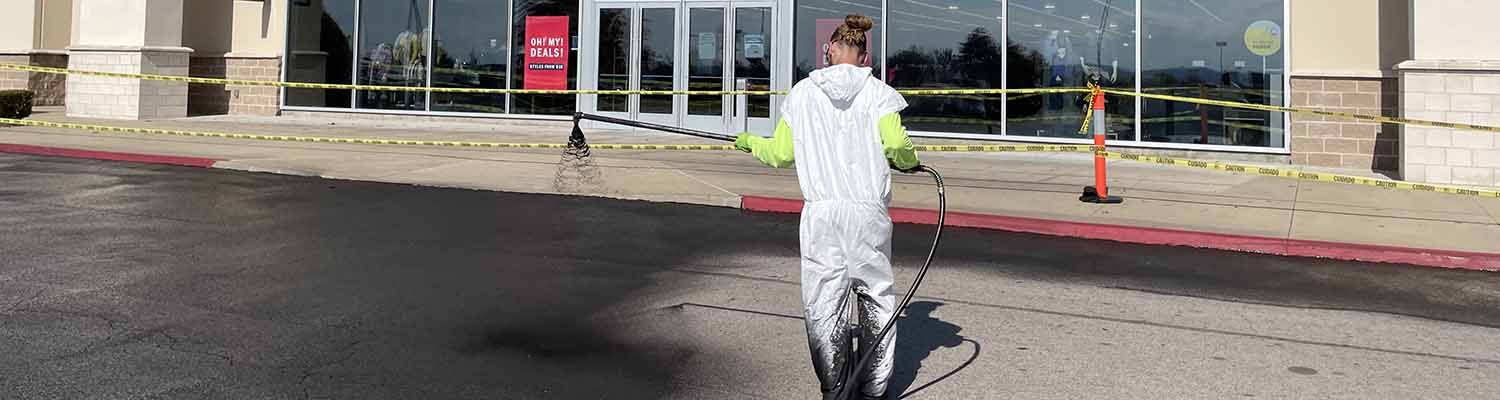
Sealcoating is the single most cost effective response to summer pavement damage, and it is the service we install more of between June and September than any other. A quality sealcoat is a liquid coating, typically an asphalt emulsion or a coal tar alternative, that is applied in two thin coats over a clean, prepared surface.
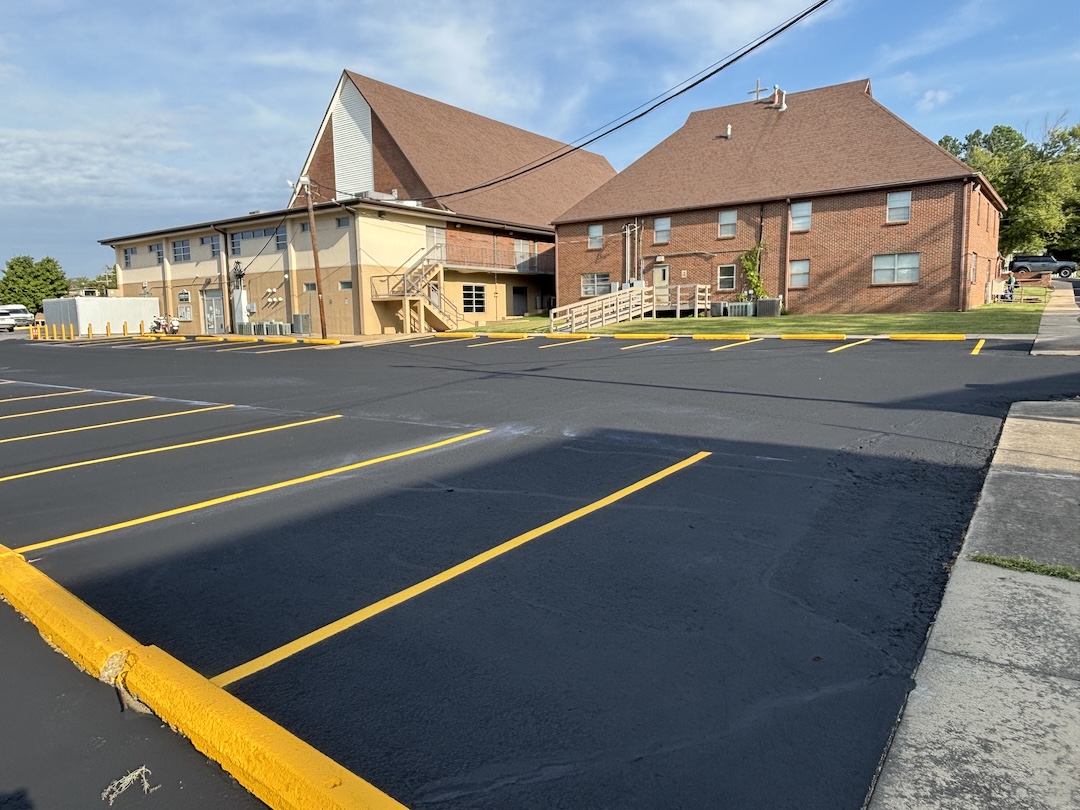
The coating does three critical jobs. It blocks ultraviolet radiation from reaching the binder underneath, effectively pausing the oxidation clock. It fills small surface voids and hairline cracks, closing the pathways that let water into the pavement structure. And it restores the deep black color that makes striping pop and makes a property look actively cared for.
A properly applied sealcoat on a commercial lot lasts two to four years in Arkansas depending on traffic, and the return on investment is dramatic. A sealcoat application typically costs a small fraction of what a mill and overlay costs per square foot, and it can extend the useful life of an asphalt surface by seven to ten years when applied on schedule.
Why Crack Sealing Comes First
Sealcoating alone cannot fix a lot that is already cracking. Any crack wider than about a quarter inch needs to be addressed with hot applied rubberized crack sealant before the sealcoat goes down. This is a step that budget contractors often skip, and it is the number one reason sealcoat jobs fail within a year.
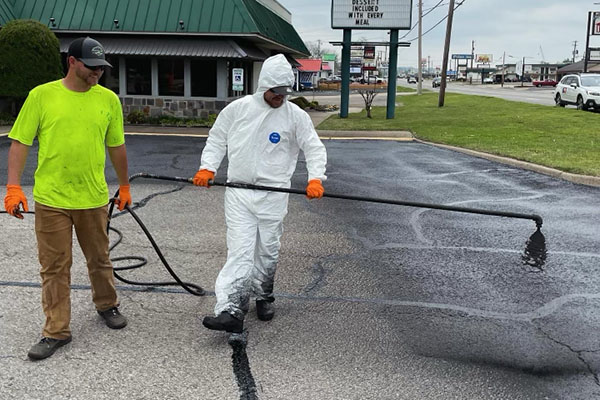
Rubberized crack sealant is heated to around 380 degrees and poured into cleaned out cracks, where it bonds to both sides and remains flexible through summer expansion and winter contraction. When we spec a summer maintenance package, crack sealing is almost always the first line item, followed by pothole patching, then sealcoating, then striping. That sequence is not arbitrary. Each step depends on the one before it.
The Best Time to Schedule Summer Work
Sealcoating requires a specific weather window. Air and surface temperatures need to be above 50 degrees and rising, with no rain in the forecast for at least 24 hours after application. In Northwest Arkansas that gives us a workable season from roughly late April through early October, with the sweet spot falling in June and July when overnight temperatures stay warm and cure times are shortest.
We recommend booking summer maintenance projects in the spring for two reasons. First, our crew calendar fills up quickly once the weather turns. Second, scheduling early lets us walk your lot during a dry stretch, identify every crack and failed area, and put together a scope that catches problems before the first big July storm.
Get a Free Summer Assessment
If your Northwest Arkansas property has not had a full pavement walkthrough this year, now is the time. Our team offers free on site assessments across Fayetteville, Springdale, Rogers, Bentonville, Cave Springs, Centerton, and the surrounding communities. We will map every crack, measure every failed area, and give you a written scope with clear pricing and no pressure.
Call our Northwest Arkansas office at (479) 547-1111 or request a free estimate online. A single summer of proactive maintenance almost always costs less than one winter of reactive repairs.