Parking Lot Paving Cost in Arkansas: A Commercial Owner's Guide
The first question on almost every commercial paving call is the same one: what is this going to cost? It is a fair question and a frustrating one, because the honest answer starts with "it depends" and then requires ten minutes of explanation about base condition, drainage, access, and thickness.
This guide gives you the actual ranges we see across Northwest Arkansas and the River Valley, the variables that move the number, and a framework for budgeting parking lot paving as a capital line item instead of an emergency.
Typical Cost Ranges in Arkansas
These are working ranges for commercial parking lots in our region. Use them for planning, not for signing.
| Scope of work | Typical range per square foot |
|---|---|
| --- | --- |
| Sealcoating, two coats | $0.18 to $0.30 |
| Crack sealing | $1.00 to $3.00 per linear foot |
| Pothole patching, spot repair | $3.00 to $8.00 |
| Full-depth patching | $6.00 to $12.00 |
| Mill and overlay, 2 inch | $2.50 to $4.50 |
| Overlay without milling | $2.00 to $3.50 |
| Full-depth new asphalt over prepared base | $4.00 to $7.50 |
| New construction including base and grading | $6.00 to $12.00 |
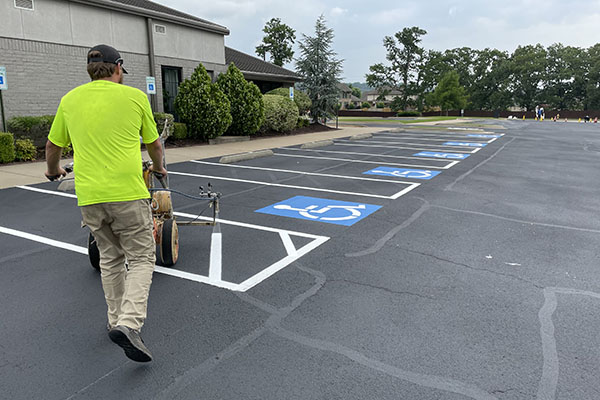
| Striping, restripe existing layout | $0.10 to $0.20 |
A 50,000 square foot retail lot needing a 2 inch mill and overlay lands roughly between $125,000 and $225,000. The same lot needing only crack sealing, patching, sealcoat, and restriping might come in between $18,000 and $32,000. That gap is why condition assessment matters more than any price list.
What Actually Drives the Number
Base condition
This is the single largest variable and the one owners underestimate most. If the aggregate base underneath the asphalt is sound, you can resurface. If water has gotten into the base and it has softened, no amount of new asphalt on top will hold. Alligator cracking, birdbaths that hold water for days, and edges that pump fines when a truck rolls over them all signal base failure. Full-depth repair of failed base sections can double the cost of an otherwise routine overlay.
Asphalt thickness
Thickness is specified based on traffic loading. A church lot that sees passenger cars twice a week and a distribution yard that sees loaded semis daily need very different sections. Typical commercial specs run 2 to 3 inches of surface course over 4 to 8 inches of compacted aggregate base for light traffic, and considerably more for heavy truck loading. Every extra inch of asphalt is real material cost, so specifying too thick wastes money and specifying too thin guarantees premature failure.
Drainage and grading
Standing water is the enemy of asphalt. If your lot has low spots that hold water after a rain, correcting the grade is part of the job. That may mean additional material to build up low areas, or milling down high spots, or in some cases adding or relocating drainage structures. Ignoring drainage on a repave means paying for the same repair again in five years.
Site access and phasing
A wide-open lot on a vacant property is the cheapest scenario. A grocery store that must stay open, with the work split into four phases across two weeks, with traffic control and overnight paving, costs meaningfully more for the same square footage. Access constraints, tight corners, and obstacles like islands, bollards, and drive-thru lanes all slow production.
Removal and disposal
Milling generates material that has to be hauled and disposed of. Full-depth removal generates more. Tonnage-based disposal costs vary and should appear as a line item, not get buried in a lump sum.
Season and material pricing
Asphalt binder is a petroleum product, so mix pricing moves with oil markets. Bids typically hold for 30 days. Late-season work can also carry weather risk premiums.
Repair, Resurface, or Replace?
The cheapest path is almost always the one that preserves what you already have. Use this rough decision framework:
- Surface is sound, cracks under a quarter inch, no potholes. Crack seal and sealcoat. Repeat every 2 to 4 years.
- Isolated failures, otherwise sound surface. Full-depth patch the failures, then crack seal and sealcoat the rest.
- Widespread surface cracking, base still solid. Mill and overlay 2 inches.
- Base failure across more than roughly 30 percent of the lot. Full-depth reconstruction on the failed areas, or complete replacement.
Our mill and overlay vs full depth repave post walks through the decision in more detail with the specific conditions that push a lot from one category to the next.
The Cost of Waiting
Deferring maintenance is not free. It is a loan against your capital budget at a very high interest rate.
A quarter-inch crack costs a couple of dollars per linear foot to seal. Left open, it lets water into the base. Water plus Arkansas freeze-thaw cycling turns that crack into a pothole, which costs $3 to $8 per square foot to patch. The pothole spreads into alligator cracking across the surrounding area, which pushes you toward a full-depth repair at $6 to $12 per square foot. Let that spread across a third of the lot and you are pricing a reconstruction instead of a sealcoat.
Put differently: a $22,000 maintenance cycle deferred for five years frequently becomes a $180,000 reconstruction. The pavement did not get more expensive. The scope did.
Building a Realistic Budget
For commercial properties, we recommend budgeting pavement in three buckets:
- Annual operating: crack sealing, pothole patching, sweeping. Small, predictable, roughly $0.02 to $0.06 per square foot per year on a lot in decent condition.
- Cyclical: sealcoating and restriping every 2 to 4 years. Roughly $0.28 to $0.50 per square foot at each cycle.
- Capital: mill and overlay every 12 to 18 years, full reconstruction every 25 to 30 years on a well-maintained lot.
Spreading the capital number across the years between events turns a shocking one-time expense into a manageable annual reserve. A 50,000 square foot lot facing a $175,000 overlay in 15 years needs roughly $11,700 a year set aside, and that number is a lot easier to defend in a budget meeting than an emergency ask.
What to Require in Every Paving Bid
Whatever you spend, make sure the bid documents these items so you can compare apples to apples:
- Measured square footage taken on site
- Mix design and compacted thickness in inches
- Base preparation and any undercut or full-depth repair, priced separately
- Grading and drainage corrections
- Milling depth and disposal
- Compaction method and density target
- Striping scope including ADA stall counts
- Phasing plan and cure times before reopening
- Written warranty with a defined start date
Get an Itemized Number for Your Lot
Every parking lot is different, and no price table replaces a walkthrough. We will measure your property on site, assess base condition, and give you an itemized written estimate you can take straight into a budget meeting.
See our parking lot paving services or request a free estimate and we will get you a real number.